Visualizzazione post con etichetta story. Mostra tutti i post

Parrots Over Puerto Rico Book

Parrots Over Puerto Rico

By Susan L. Roth, Cindy Trumbore
Illustrated by Susan L. Roth

Above the treetops of Puerto Rico flies a flock of parrots as green as their island home. . . . These are Puerto Rican parrots. They lived on this island for millions of years, and then they nearly vanished from the earth forever. 


Puerto Rican parrots, once abundant, came perilously close to extinction in the 1960s due to centuries of foreign exploration and occupation, development, and habitat destruction. In this compelling book, Roth and Trumbore recount the efforts of the scientists of the Puerto Rican Parrot Recovery Program to save the parrots and ensure their future. Woven into the parrots’ story is a brief history of Puerto Rico itself, from before the first human settlers to the present day. 


With striking collage illustrations, a unique format, and engaging storytelling, Parrots Over Puerto Rico invites readers to witness the amazing recovery efforts that have enabled Puerto Rican parrots to fly over their island once again. 


Aesop's Fables: The parrot and the cat

THE PARROT AND THE CAT

A Man once bought a Parrot and gave it the run of his house. It revelled in its liberty, and presently flew up on to the mantelpiece and screamed away to its heart's content. The noise disturbed the Cat, who was asleep on the hearthrug. Looking up at the intruder, she said, "Who may you be, and where have you come from?" The Parrot replied, "Your master has just bought me and brought me home with him." "You impudent bird," said the Cat, "how dare you, a newcomer, make a noise like that? Why, I was born here, and have lived here all my life, and yet, if I venture to mew, they throw things at me and chase me all over the place." "Look here, mistress," said the Parrot, "you just hold your tongue. My voice they delight in; but yours—yours is a perfect nuisance."

Minnie's pet parrot - Children Book (1864)

Herriette Newell Woods was born on August 19, 1815 in Andover, Massachusetts. She began writing at an early age and had her first story published at age 10. Baker attended Abbot Female Seminary. She married Abijah Richardson Baker on October, 1 1835. Baker's first books were published in 1860 under the pseudonym Mrs. Madeline Leslie. It is believed that she went on to write anonymously or pseudonymously over 200 books. One of her other common pseudonym was Aunt Hattie. Many of her books had a religious or moral theme and her style was considered very true to life, with well drawn characters. She died in New York on April 26, 1893.


Minnie's Pet Parrot - 1864

Author: Mrs. Madeline Leslie (1815-1893)
Published: 1864
Source: http://www.archive.org/details/minniespetparrot00lesliala 
Read the story online: http://www.gutenberg.org/files/26617/26617-h/26617-h.htm
Download Pdf: http://www.archive.org/download/minniespetparrot00lesliala/minniespetparrot00lesliala.pdf
Summary:  The object of these little books is not so much to give full, scientific information with regard to the animals of which they treat, as to bring before the child such facts concerning them as shall interest him in their history, awaken a desire to know more of the particular traits of each, and especially lead him to be kind to them as a part of God’s creation.


Lady Isabel and the Elf Knight ballad (or May Colvin ballad)

The song appears in many variants but the main theme is that the knight of the title woos the lady with music, or abducts her, and carries her off to a deep wood or seaside, where he tells her that he has killed seven (or more) other women and plans to do the same to her. In many European versions it is made explicit that he proposes to "dishonour" her as well. She, however, distracts him by one of a number of means and then contrives to kill him in her stead.

Some variants include a curious final section in which the lady returns home and engages in conversation with a parrot in a cage. She usually makes a bargain with the bird that she will give it a golden cage if it refrains from telling her father of the escapade with the knight.


May Colven

1.False Sir John a wooing came
To a maid of beauty fair;
May Colven was this lady's name,
Her father's only heir.

2. He wood her butt, he wood her ben,
He wood her in the ha,
Until he got this lady's consent
To mount and ride awa.

3. He went down to her father's bower,
Where all the steeds did stand,
And he's taken one of the best steeds
That was in her father's land.

4. He's got on and she's got on,
As fast as they could flee,
Until they came to a lonesome part,
A rock by the side of the sea.

5. "Loup off the steed," says false Sir John,
"Your bridal bed you see;
For I have drowned seven young ladies,
The eighth one you shall be.

6. "Cast off, cast off, my May Colven,
All and your silken gown,
For it's oer good and oer costly
To rot in the salt sea foam.

7. "Cast off, cast off, my May Colven.
All and your embroiderd shoen,
For oer good and oer costly
To rot in the salt sea foam."

8. "O turn you about, O false Sir John,
And look to the leaf of the tree,
For it never became a gentleman
A naked woman to see."

9. He turned himself straight round about,
To look to the leaf of the tree,
So swift as May Colven was
To throw him in the sea.
10. "O help, O help, my May Colven,
O help, or else I'll drown;
I'll take you home to your father's bower,
And set you down safe and sound."

11. "No help, no help, O false Sir John,
No help, nor pity thee;
Tho' seven kings' daughters you have drownd,
But the eighth shall not be me."

12. So she went on her father's steed,
As swift as she could flee,
And she came home to her father's bower
Before it was break of day.

13. Up then and spoke the pretty parrot:
"May Colven, where have you been?
What has become of false Sir John,
That woo'd you so late the streen?

14. "He woo'd you butt, he woo'd you ben,
He woo'd you in the ha,
Until he got your own consent
For to mount and gang awa."

15. "O hold your tongue, my pretty parrot,
Lay not the blame upon me;
Your cup shall be of the flowered gold,
Your cage of the root of the tree."

16. Up then spake the king himself,
In the bed-chamber where he lay:
"What ails the pretty parrot,
That prattles so long or day?"

17. "There came a cat to my cage door,
It almost a worried me,
And I was calling on May Colven
To take the cat from me."


Little Women by Louisa May Alcott

Little Women is a novel by American author Louisa May Alcott (1832–1888). The book was published in two volumes in 1868 and 1869. The novel follows the lives of four sisters—Meg, Jo, Beth, and Amy March—and is loosely based on the author's childhood experiences with her three sisters. The first volume was an immediate commercial and critical success, prompting the composition of the book's second volume titled Good Wives, which was successful as well.


Chapter 5

[...]Laurie opened his mouth to ask another question, but remembering just in time that it wasn’t manners to make too many inquiries into people’s affairs, he shut it again, and looked uncomfortable.

Jo liked his good breeding, and didn’t mind having a laugh at Aunt March, so she gave him a lively description of the fidgety old lady, her fat poodle, the parrot that talked Spanish, and the library where she reveled.

Laurie enjoyed that immensely, and when she told about the prim old gentleman who came once to woo Aunt March, and in the middle of a fine speech, how Poll had tweaked his wig off to his great dismay, the boy lay back and laughed till the tears ran down his cheeks, and a maid popped her head in to see what was the matter.

‘Oh! That does me no end of good. Tell on, please,’ he said, taking his face out of the sofa cushion, red and shining with merriment. [...]


Chapter 17

[...] Dr. Bangs came, said Beth had symptoms of the fever, but he thought she would have it lightly, though he looked sober over the Hummel story. Amy was ordered off at once, and provided with something to ward off danger, she departed in great state, with Jo and Laurie as escort.

Aunt March received them with her usual hospitality.

‘What do you want now?’ she asked, looking sharply over her spectacles, while the parrot, sitting on the back of her chair, called out...

‘Go away. No boys allowed here.’

Laurie retired to the window, and Jo told her story.

‘No more than I expected, if you are allowed to go poking about among poor folks. Amy can stay and make herself useful if she isn’t sick, which I’ve no doubt she will be, looks like it now. Don’t cry, child, it worries me to hear people sniff.’ Amy was on the point of crying, but Laurie slyly pulled the parrot’s tail, which caused Polly to utter an astonished croak and call out, ‘Bless my boots!’ in such a funny way, that she laughed instead.

‘What do you hear from your mother?’ asked the old lady gruffly.

‘Father is much better,’ replied Jo, trying to keep sober.

‘Oh, is her? Well, that won’t last long, I fancy. March never had any stamina,’ was the cheerful reply.

‘Ha, ha! Never say die, take a pinch of snuff, goodbye, goodbye!’ squalled Polly, dancing on her perch, and clawing at the old lady’s cap as Laurie tweaked him in the rear.

‘Hold your tongue, you disrespectful old bird! And, Jo, you’d better go at once. It isn’t proper to be gadding about so late with a rattlepated boy like..’

‘Hold your tongue, you disrespectful old bird!’ cried Polly, tumbling off the chair with a bounce, and running to peck the ‘rattlepated’ boy, who was shaking with laughter at the last speech.

‘I don’t think I can bear it, but I’ll try,’ thought Amy, as she was left alone with Aunt March.

‘Get along, you fright!’ screamed Polly, and at that rude speech Amy could not restrain a sniff.


Chapter 19

While these things were happening at home, Amy was having hard times at Aunt March’s. She felt her exile deeply, and for the first time in her life, realized how much she was beloved and petted at home. Aunt March never petted any one. She did not approve of it, but she meant to be kind, for the well- behaved little girl pleased her very much, and Aunt March had a soft place in her old heart for her nephew’s children, though she didn’t think it proper to confess it. She really did her best to make Amy happy, but, dear me, what mistakes she made. Some old people keep young at heart in spite of wrinkles and gray hairs, can sympathize with children’s little cares and joys, make them feel at home, and can hide wise lessons under pleasant plays, giving and receiving friendship in the sweetest way. But Aunt March had not this gift, and she worried Amy very much with her rules and orders, her prim ways, and long, prosy talks. Finding the child more docile and amiable than her sister, the old lady felt it her duty to try and counteract, as far as possible, the bad effects of home freedom and indulgence. So she took Amy by the hand, and taught her as she herself had been taught sixty years ago, a process which carried dismay to Amy’s soul, and made her feel like a fly in the web of a very strict spider.

She had to wash the cups every morning, and polish up the old-fashioned spoons, the fat silver teapot, and the glasses till they shone. Then she must dust the room, and what a trying job that was. Not a speck escaped Aunt March’s eye, and all the furniture had claw legs and much carving, which was never dusted to suit. Then Polly had to be fed, the lap dog combed, and a dozen trips upstairs and down to get things or deliver orders, for the old lady was very lame and seldom left her big chair. After these tiresome labors, she must do her lessons, which was a daily trial of every virtue she possessed. Then she was allowed one hour for exercise or play, and didn’t she enjoy it?

Laurie came every day, and wheedled Aunt March till Amy was allowed to go out with him, when they walked and rode and had capital times. After dinner, she had to read aloud, and sit still while the old lady slept, which she usually did for an hour, as she dropped off over the first page. Then patchwork or towels appeared, and Amy sewed with outward meekness and inward rebellion till dusk, when she was allowed to amuse herself as she liked till teatime. The evenings were the worst of all, for Aunt March fell to telling long stories about her youth, which were so unutterably dull that Amy was always ready to go to be, intending to cry over her hard fate, but usually going to sleep before she had squeezed out more than a tear or two.

If it had not been for Laurie, and old Esther, the maid, she felt that she never could have got through that dreadful time. The parrot alone was enough to drive her distracted, for he soon felt that she did not admire him, and revenged himself by being as mischievous as possible. He pulled her hair whenever she came near him, upset his bread and milk to plague her when she had newly cleaned his cage, made Mop bark by pecking at him while Madam dozed, called her names before company, and behaved in all respects like an reprehensible old bird. Then she could not endure the dog, a fat, cross beast who snarled and yelped at her when she made his toilet, and who lay on his back with all his legs in the air and a most idiotic expression of countenance when he wanted something to eat, which was about a dozen times a day. The cook was bad-tempered, the old coachman was deaf, and Esther the only one who ever took any notice of the young lady.

Esther was a Frenchwoman, who had lived with‘Madame’, as she called her mistress, for many years, and who rather tyrannized over the old lady, who could not get along without her. Her real name was Estelle, but Aunt March ordered her to change it, and she obeyed, on condition that she was never asked to change her religion. She took a fancy to Mademoiselle, and amused her very much with odd stories of her life in France, when Amy sat with her while she got up Madam’s laces. She also allowed her to roam about the great house, and examine the curious and pretty things stored away in the big wardrobes and the ancient chests, for Aunt March hoarded like a magpie. Amy’s chief delight was an Indian cabinet, full of queer drawers, little pigeonholes, and secret places, in which were kept all sorts of ornaments, some precious, some merely curious, all more or less antique. To examine and arrange these things gave Amy great satisfaction, especially the jewel cases, in which on velvet cushions reposed the ornaments which had adorned a belle forty years ago. There was the garnet set which Aunt March wore when she came out, the pearls her father gave her on her wedding day, her lover’s diamonds, the jet mourning rings and pins, the queer lockets, with portraits of dead friends and weeping willows made of hair inside, the baby bracelets her one little daughter had worn, Uncle March’s big watch, with the red seal so many childish hands had played with, and in a box all by itself lay Aunt March’s wedding ring, too small now for her fat finger, but put carefully away like the most precious jewel of them all.

‘Which would Mademoiselle choose if she had her will?’ asked Esther, wo always sat near to watch over and lock up the valuables.

‘I like the diamonds best, but there is no necklace among them, and I’m fond of necklaces, they are so becoming. I should choose this if I might,’ replied Amy, looking with great admiration at a string of gold and ebony beads from which hung a heavy cross of the same.

‘I, too, covet that, but not as a necklace. Ah, no! To me it is a rosary, and as such I should use it like a good catholic,’ said Esther, eyeing the handsome thing wistfully.

‘Is it meant to use as you use the string of good-smelling wooden beads hanging over your glass?’ asked Amy.

‘Truly, yes, to pray with. It would be pleasing to the saints if one used so fine a rosary as this, instead of wearing it as a vain bijou.’

‘You seem to take a great deal of comfort in your prayers, Esther, and always come down looking quiet and satisfied. I wish I could.’

‘If Mademoiselle was a Catholic, she would find true comfort, but as that is not to be, it would be well if you went apart each day to meditate and pray, as did the good mistress whom I served before Madame. She had a little chapel, and in it found solacement for much trouble.’

‘Would it be right for me to do so too?’ asked Amy, who in her loneliness felt the need of help of some sort, and found that she was apt to forget her little book, now that Beth was not there to remind her of it.

‘It would be excellent and charming, and I shall gladly arrange the little dressing room for you if you like it. Say nothing to Madame, but when she sleeps go you and sit alone a while to think good thoughts, and pray the dear God preserve your sister.’

Esther was truly pious, and quite sincere in her advice, for she had an affectionate heart, and felt much for the sisters in their anxiety. Amy liked the idea, and gave her leave to arrange the light closet next her room, hoping it would do her good.

‘I wish I knew where all these pretty things would go when Aunt March dies,’ she said, as she slowly replaced the shining rosary and shut the jewel cases one by one.

‘To you and your sisters. I know it, Madame confides in me. I witnessed her will, and it is to be so,’ whispered Esther smiling.

‘How nice! But I wish she’d let us have them now. Procrastination is not agreeable,’ observed Amy, taking a last look at the diamonds.

‘It is too soon yet for the young ladies to wear these things. The first one who is affianced will have the pearls, Madame has said it, and I have a fancy that the little turquoise ring will be given to you when you go, for Madame approves your good behavior and charming manners.’

‘Do you think so? Oh, I’ll be a lamb, if I can only have that lovely ring! It’s ever so much prettier than Kitty Bryant’s. I do like Aunt March after all.’ And Amy tried on the blue ring with a delighted face and a firm resolve to earn it.

From that day she was a model of obedience, and the old lady complacently admired the success of her training. Esther fitted up the closet with a little table, placed a footstool before it, and over it a picture taken from one of the shut-up rooms. She thought it was of no great value, but, being appropriate, she borrowed it, well knowing that Madame would never know it, nor care if she did. It was, however, a very valuable copy of one of the famous pictures of the world, and Amy’s beauty-loving eyes were never tired of looking up at the sweet face of the Divine Mother, while her tender thoughts of her own were busy at her heart. On the table she laid her little testament and hymnbook, kept a vase always full of the best flowers Laurie brought her, and came every day to ‘sit alone’ thinking good thoughts, and praying the dear God to preserve her sister. Esther had given her a rosary of black beads with a silver cross, but Amy hung it up and did not use it, feeling doubtful as to its fitness for Protestant prayers.

The little girl was very sincere in all this, for being left alone outside the safe home nest, she felt the need of some kind hand to hold by so sorely that she instinctively turned to the strong and tender Friend, whose fatherly love most closely surrounds His little children. She missed her mother’s help to understand and rule herself, but having been taught where to look, she did her best to find the way and walk in it confidingly. But Amy was a young pilgrim, and just now her burden seemed very heavy. She tried to forget herself, to keep cheerful, and be satisfied with doing right, though no one saw or praised her for it. In her first effort at being very, very good, she decided to make her will, as Aunt March had done, so that if she did fall ill and die, her possessions might be justly and generously divided. It cost her a pang even to think of giving up the little treasures which in her eyes were as precious as the old lady’s jewels.

During one of her play hours she wrote out the important document as well as she could, with some help from Esther as to certain legal terms, and when the good-natured Frenchwoman had signed her name, Amy felt relieved and laid it by to show Laurie, whom she wanted as a second witness. As it was a rainy day, she went upstairs to amuse herself in one of the large chambers, and took Polly with her for company. In this room there was a wardrobe full of old-fashioned costumes with which Esther allowed her to play, and it was her favorite amusement to array herself in the faded brocades, and parade up and down before the long mirror, making stately curtsies, and sweeping her train about with a rustle which delighted her ears. So busy was she on this day that she did not hear Laurie’s ring nor see his face peeping in at her as she gravely promenaded to and fro, flirting her fan and tossing her head, on which she wore a great pink turban, contrasting oddly with her blue brocade dress and yellow quilted petticoat. She was obliged to walk carefully, for she had on highheeled shoes, and, as Laurie told Jo afterward, it was a comical sight to see her mince along in her gay suit, with Polly sidilng and bridling just behind her, imitating her as well as he could, and occasionally stopping to laugh or exclaim, ‘Ain’t we fine? Get along, you fright! Hold your tongue! Kiss me, dear! Ha! Ha!’

Having with difficulty restrained an explosion of merriment, lest it should offend her majesty, Laurie tapped and was graciously received.

‘Sit down and rest while I put these things away, then I want to consult you about a very serious matter,’ said Amy, when she had shown her splendor and driven Polly into a corner. ‘That bird is the trial of my life,’ she continued, removing the pink mountain from her head, while Laurie seated himself astride a chair. ‘Yesterday, when Aunt was asleep and I was trying to be as still as a mouse, Polly began to squall and flap about in his cage, so I went to let him out, and found a big spider there. I poked it out, and it ran under the bookcase. Polly marched straight after it, stooped down and peeped under the bookcase, saying, in his funny way, with a cock of his eye, ‘Come out and take a walk, my dear.’ I couldn’t help laughing, which made Poll swear, and Aunt woke up and scolded us both.’ ‘Did the spider accept the old fellow’s invitation?’ asked Laurie, yawning.

‘Yes, out it came, and away ran Polly, frightened to death, and scrambled up on Aunt’s chair, calling out, ‘Catch her! Catch her! Catch her!’ as I chased the spider.’

‘That’s a lie! Oh, lor!’ cried the parrot, pecking at Laurie’s toes.

‘I’d wring your neck if you were mine, you old torment,’ cried Laurie, shaking his fist at the bird, who put his head on one side and gravely croaked, ‘Allyluyer! Bless your buttons, dear!’

‘Now I’m ready,’ said Amy, shutting the wardrobe and taking a piece of paper out of her pocket. ‘I want you to read that, please, and tell me if it is legal and right. I felt I ought to do it, for life is uncertain and I don’t want any ill feeling over my tomb.’

Laurie bit his lips, and turning a little from the pensive speaker, read the following document, with praiseworthy gravity, considering the spelling:

MY LAST WILL AND TESTIMENT

I, Amy Curtis March, being in my sane mind, go give and bequeethe all my earthly property—viz.to wit:—namely To my father, my best pictures, sketches, maps, and works of art, including frames. Also my $100, to do what he likes with.

To my mother, all my clothes, except the blue apron with pockets—also my likeness, and my medal, with much love.

To my dear sister Margaret, I give my turkquoise ring (if I get it), also my green box with the doves on it, also my; piece of real lace for her neck, and my sketch of her as a memorial of her ‘little girl’.

To Jo I leave my breastpin, the one mended with sealing wax, also my bronze inkstand—she lost the cover—and my most precious plaster rabbit, because I am sorry I burned up her story.

To Beth (if she lives after me) I give my dolls and the little bureau, my fan, my linen collars and my new slippers if she can wear them being thin when she gets well. And I herewith also leave her my regret that I ever made fun of old Joanna.

To my friend and neighbor Theodore Laurence I bequeethe my paper mashay portfolio, my clay model of a horse though he did say it hadn’t any neck. Also in return for his great kindness in the hour of affliction any one of my artistic works he likes, Noter Dame is the best.

To our venerable benefactor Mr. Laurence I leave my purple box with a looking glass in the cover which will be nice for his pens and remind him of the departed girl who thanks him for his favors to her family, especially Beth.

I wish my favorite playmate Kitty Bryant to have the blue silk apron and my gold-bead ring with a kiss.

To Hannah I give the bandbox she wanted and all the patchwork I leave hoping she ‘will remember me, when it you see’.

And now having disposed of my most valuable property I hope all will be satisfied and not blame the dead. I forgive everyone, and trust we may all meet when the trump shall sound. Amen.

To this will and testiment I set my hand and seal on this 20th day of Nov. Anni Domino 1861.

Amy Curtis March

Witnesses:

Estelle Valnor, Theodore Laurence.

The last name was written in pencil, and Amy explained that he was to rewrite it in ink and seal it up for her properly.

‘What put it into your head? Did anyone tell you about Beth’s giving away her things?’ asked Laurie soberly, as Amy laid a bit of red tape, with sealing wax, a taper, and a standish before him.

She explained and then asked anxiously, ‘What about Beth?’

‘I’m sorry I spoke, but as I did, I’ll tell you. She felt so ill one day that she told Jo she wanted to give her piano to Meg, her cats to you, and the poor old doll to Jo, who would love it for her sake. She was sorry she had so little to give, and left locks of hair to the rest of us, and her best love to Grandpa. She never thought of a will.’

Laurie was signing and sealing as he spoke, and did not look up till a great tear dropped on the paper. Amy’s face was full of trouble, but she only said, ‘Don’t people put sort of postscripts to their wills, sometimes?’

‘Yes, ‘codicils’, they call them.’

‘Put one in mine then, that I wish all my curls cut off, and given round to my friends. I forgot it, but I want it done though it will spoil my looks.’

Laurie added it, smiling at Amy’s last and greatest sacrifice. Then he amused her for an hour, and was much interested in all her trials. But when he came to go, Amy held him back to whisper with trembling lips, ‘Is there really any danger about Beth?’ ‘I’m afraid there is, but we must hope for the best, so don’t cry, dear.’ And Laurie put his arm about her with a brotherly gesture which was very comforting.

When he had gone, she went to her little chapel, and sitting in the twilight, prayed for Beth, with streaming tears and an aching heart, feeling that a million turquoise rings would not console her for the loss of her gentle little sister.


_________________________


Little Women, a popular novel in Japan, has been adapted into at least four anime versions, and referenced in several others. The first anime adaptation of Little Women was an episode of the TV series Manga Sekai Mukashi Banashi ("Manga World's Classic Tales"), aired in October 1977. In 1980, director Yugo Serikawa (Mazinger Z) adapted the novel into a Toei Animation TV special titled Wakakusa Monogatari (The Story of Young Grass). The success of Serikawa's TV special was parlayed into Wakakusa no Yon Shimai ("Four Sisters of Young Grass"), a 26-episode TV series directed by Kazuya Miyazaki for the Kokusai Eigasha studio which aired on Fuji TV in 1981.


Little Women Anime Toei 1980 - Aunt March and Polly


Little Women Anime Toei 1980 - Aunt March with Polly, Amy and Beth


Little Women Anime Toei 1980 - Aunt March with Meg


Little Women Anime Toei 1980 - Aunt March and Polly

"The Widow and the Parrot" by Virginia Woolf

The Widow and the Parrot: A True Story
by Virginia Woolf (1882 – 1941)

Some fifty years ago Mrs Gage, an elderly widow, was sitting in her cottage in a village called Spilsby in Yorkshire. Although lame, and rather short sighted she was doing her best to mend a pair of clogs, for she had only a few shillings a week to live on. As she hammered at the clog, the postman opened the door and threw a letter into her lap.
It bore the address ‘Messrs Stagg and Beetle, 67 High Street, Lewes, Sussex.'

Mrs Gage opened it and read: ‘Dear Madam; We have the honour to inform you of the death of your brother Mr Joseph Brand.'

‘Lawk a mussy,‘ said Mrs Gage. ‘Old brother Joseph gone at last!’

‘He has left you his entire property', the letter went on, ‘which consists of a dwelling house, stable, cucumber frames, mangles, wheelbarrows &c &c. in the village of Rodmell, near Lewes. He also

bequeaths to you his entire fortune; Viz: £ 3,000. (three thousand pounds) sterling.'

Mrs Gage almost fell into the fire with joy. She had not seen her brother for many years, and, as he did not even acknowledge the Christmas card which she sent him every year, she thought that his miserly habits, well knovm to her from childhood, made him grudge even a penny stamp for a reply. But now it had all tumed out to her advantage. With three thousand pounds, to say nothing of house &c &c, she and her family could live in great luxury for ever.

She determined that she must visit Rodmell at once. The village clergyman, the Rev Samuel Tallboys, lent her two pound ten, to pay her fare, and by next day all preparations for her journey were complete. The most important of these was the care of her dog Shag during her absence, for in spite of her poverty she was devoted to animals, and often went short herself rather than stint her dog of his bone.

She reached Lewes late on Tuesday night. In those days, I must tell you, there was no bridge over the river at Southease, nor had the road to Newhaven yet been made. To teach Rodmell it was necessary to cross he river Ouse by a ford, traces of which still exist, but this could only be attempted at low tide, when the stones on the river bed appeared above the water. Mr Stacey, the farmer, was going to Rodmell in his cart, and he kindly offered to take Mrs Gage with him. They reached Rodmell about nine o‘clock on a November night and. Mr Stacey obligingly pointed out to Mrs Gage the house at the end of the village which had been left her by her brother. Mrs Gage knocked at the door. There was no answer. She knocked again. A very strange high voice shrieked out ‘Not at home.’ She was so much taken aback that if she had not heard footsteps coming she would have run away. However the door was opened by an old village woman, by name Mrs Ford.

‘Who was that shrieking out "Not at home"? said Mrs Gage.

‘Drat the bird’ said Mrs Ford very peevishly, pointing to a large grey parrot. ‘He almost screams my bead off. There he sits all day humped up on his perch like a monument screeching "Not at home" if ever you go near his perch.' He was a very handsome bird, as Mrs Gage could see; but his feathers were sadly neglected. ‘Perhaps he is unhappy, or he may be hungry,’ she said. But Mrs Ford said it was temper merely; he was a seaman’s parrot and had learnt his language in the east. However, she added, Mr Joseph was very fond of him, had called him James; and, it was said, talked to him as if he were a rational being. Mrs Ford soon left. Mrs Gage at once went to her box and fetched some sugar which she had with her and offered it to the parrot, saying in a very kind tone that she meant him no harm, but was his old master’s sister, come to take possession of the house, and she would see to it that he was as happy as a bird could be. Taking a lantern she next went round the house to see what sort of property her brother had left her. lt was a bitter disappointment. There were holes in all the carpets. The bottoms of the chairs had fallen out. Rats ran along the mantelpiece. There were large toadstools growing through the kitchen floor. There was not a stick of fumiture worth seven pence halfpenny; and Mrs Gage only cheered herself by thinking of the three thousand pounds that lay safe and snug in Lewes Bank.

She determined to set off to Lewes next day in order to claim her money from Messrs Stagg and Beetle the solicitors, and then to return home as quick as she oould. Mr Stacey, who was going to market with some fine Berkshire pigs, again offered to take her with him, and told her some terrible stories of young people who had been drowned through trying to cross the river at high tide, as they drove. A great disappointment was in store for the poor old woman directly she got in to Mr Stagg’s office.

‘Pray take a seat, Madam,’ he said, looking very solemn and grunting slightly. ‘The fact is,' he went on, ‘that you must prepare to face some very disagreeable news. Since I wrote to you I have gone carefully through Mr Brand’s papers. I regret to say that I can find no trace whatever of the three thousand pounds. Mr Beetle, my partner, went himself to Rodmell and searched the premises with the utmost care. He found absolutely nothing - no gold, silver, or valuables of any kind - except a fine grey parrot which I advise you to sell for whatever he will fetch. His language, Benjamin Beetle said, is very extreme. But that is neither here nor there. I much fear you have had your journey for nothing. The premises are dilapidated; and of course our expenses are considerable.' Here he stopped, and Mrs Gage well knew that he wished her to go. She was almost crazy with disappointment. Not only had she borrowed two pound ten from the Rev. Samuel Tallboys, but she would return home absolutely empty handed, for the parrot James would have to be sold to pay her fare. It was raining hard, but Mr Stagg did not press her to stay, and she was too beside herself with sorrow to care what she did. In spite of the rain she started to walk back to Rodrnell across the meadows.

Mrs Gage, as I have already said, was lame in her right leg. At the best of times she walked slowly, and now, what with her disappointment and the mud on the bank her progress was very slow indeed. As she plodded along, the day grew darker and darker, until it was as much as she could do to keep on the raised path by the river side. You might have heard her grumbling as she walked, and complaining of her crafty brother Joseph, who had put her to all this trouble ‘Express,’ she said, ‘to plague me. He was always a cruel little boy when we were children,' she went on. ‘He liked worrying the poor insects, and I’ve known him trim a hairy caterpillar with a pair of scissors before my very eyes. He was such a miserly varrnint too. He used to hide his pocket money in a tree, and if anyone gave him a piece of iced cake for tea, he cut the sugar off and kept it for his supper. I make no doubt he’s all aflame at this very moment in Hell fire, but what‘s the comfort of that to me?’ she asked, and indeed it was very little comfort, for she ran slap into a great cow which was coming along the bank, and rolled over and over in the mud.

She picked herself up as best she could and trudged on again. It seemed to her that she had been walking for hours. It was now pitch dark and she could scarcely see her own hand before her nose. Suddenly she bethought her of Farmer Stacey’s words about the ford. ‘Lawk a mussy,’ she said, ‘however shall I find my way across? If the tide‘s in, I shall step into deep water and be swept out to sea in a jiffy! Many’s the couple that been drowned here; to say nothing of horses, carts, herds of cattle, and stacks of hay.’

Indeed what with the dark and the mud she had got herself into a pretty pickle. She could hardly see the river itself, let alone tell whether she had reached the ford or not. No lights were visible anywhere, for, as you may be aware, there is no cottage or house on that side of the river nearer than Asheham House, lately the seat of Mr Leonard Woolf. It seemed that there was nothing for it but to sit down and wait for the morning. But at her age, with the rheumatics in her system, she might well die of cold. On the other hand, if she tried to cross the river it was almost certain that she would be drowned. So miserable was her state that she would gladly have changed places with one of the cows in the field. No more wretched old woman could have been found in the whole county of Sussex; standing on the river bank, not knowing whether to sit or to swim, or merely to roll over in the grass, wet though it was, and sleep or freeze to death, as her fate decided.

At that moment a wonderful thing happened. An enormous light shot up into the sky, like a gigantic torch, lighting up every blade of grass, and showing her the ford not twenty yards away. It was low tide, and the crossing would be an easy matter if only the light did not go out before she had got over.
‘It must be a Comet or some such wonderful monstrosity,’ she said as she hobbled across. She could see the village of Rodmell brilliantly up in front of her.

‘BIess us and save us!’ she cried out. ‘There’s a house on fire - thanks be to the Lord’ - for she reckoned that it would take some minutes at least to burn a house down, and in that time she would be well on her way to the village.

‘It’s an ill wind that blows nobody any good,’ she said as she hobbled along the Roman road. Sure enough, she could see every inch of the way, and was almost in the village street when for the first time it struck her, ‘Perhaps it’s my own house that‘s blazing to cinders before my eyes!'

She was perfectly right.

A small boy in his nightgown came capering up to her and cried out, ‘Come and see old Joseph Brand’s house ablaze!'

All the villagers were standing in a ring round the house handing buckets of water which were filled from the well in Monks House kitchen, and throwing them on the flames. But the fire had got a strong hold, and just as Mrs Gage arrived, the roof fell in.

‘Has anybody saved the parrot?' she cried.

‘Be thankful you’re not inside yourself, Madam,' said the Rev James Hawkesford, the clergyman. ‘Do not worry for the dumb creatures. I make no doubt the parrot was mercifully suffocated on his perch.’

But Mrs Gage was determined to see for herself. She had to be held back by the village people, who remarked that she must be crazy to hazard her life for a bird.

‘Poor old woman,’ said Mrs Ford, ‘she has lost all her property, save one old wooden box, with her night things in it. No doubt we should be crazed in her place too.’

So saying, Mrs Ford took Mrs Gage by the hand and led her off to her own cottage, where she was to sleep the night. The fire was now extinguished, and everybody went home to bed.

But poor Mrs Gage could not sleep. She tossed and tumbled thinking of her miserable state, and wondering how she could get back to Yorkshire and pay the Rev Samuel Tallboys the money she owed him. At the same time she was even more grieved to think of the fate of the poor parrot Jarnes. She had taken a liking to the bird, and thought that he must have an affectionate heart to mourn so deeply for the death of old Joseph Brand, who had never done a kindness to any human creature. It was a terrible death for an innocent bird, she thought; and if only she had been in time, she would have risked her own life to save his.

She was lying in bed thinking these thoughts when a slight tap at the window made her start. The tap was repeated three times over. Mrs Gage got out of bed as quickly as she could and went to the window. There, to her utmost surprise, sitting on the window ledge was an enormous parrot. The rain had stopped and it was a fine moonlight night. She was greatly alarmed at first, but soon recognised the grey parrot, James, and was overcome with joy at his escape. She opened the window, stroked his head several times, and told him to come in. The parrot replied by gently shaking his head from side to side, then flew to the ground, walked away a few steps, looked back as if to see whether Mrs Gage were coming, and then returned to the window sill, where she stood in amazement.

‘The creature has more meaning in its acts than we humans know,’ she said to herself. ‘Very well, James,' she said aloud, talking to him as though he were a human being, ‘l’ll take your word for it. Only wait a moment while I make myself decent.’

So saying she pinned on a large apron, crept as lightly as possible downstairs, and let herself out without rousing Mrs Ford.

The parrot James was evidently satisfied. He now hopped briskly afew yards ahead of her in the direction of the burnt house. Mrs Gage followed as fast as she could. The parrot hopped, as if he knew his way perfectly, round to the back of the house, where the kitchen had originally been. Nothing now remained of it except the brick floor,which was still dripping with the water which had been thrown to put out the fire. Mts Gage stood still in amazement while James hopped about, pecking here and there, as if he were testing the bricks with his beak. It was a very uncanny sight, and had not Mrs Gage been in the habit of living with animals, she would have lost her head, very likely, and hobbled back home. But stranger things yet were to happen. All this time the parrot had not said a word. He suddenly got into a state of the greatest excitement, fluttering his wings, tapping the floor repeatedly with his beak, and crying so shrilly, ‘Not at home! Not at home!' that Mrs Gage feared that the whole village would be roused.

‘Don't take on so James; you’ll hurt yourself,’ she said soorhingly. But he repeated his attack on the bricks more violently than ever.

‘Whatever can be the meaning of it?’ said Mrs Gage, looking carefully at the kitchen floor. The moonlight was bright enough to show her a slight unevenness in the laying of the bricks, as if they had been taken up and then relaid not quite flat with the others. She had fastened her apron with a large safety pin, and she now prised this pin between the bricks and found that they were only loosely laid together. Very soon she had taken one up in her hands. No sooner had she done this than the parrot hopped onto the brick next to it, and, tapping it smartly with his beak, cried, ‘Not at home!’ which Mrs Gage understood to mean that she was to move it. So they went on taking up the bricks in the moonlight until they had laid bare a space some six feet by four and a half. This the parrot seemed to think was enough. But what was to be done next?

Mrs Gage now rested, and determined to be guided entirely by the behaviour of the parrot James. She was not allowed to rest for long. After scratching about in the sandy foundations for a few minutes, as you may have seen a hen scratch in the sand with her claws, he unearthed what at first looked like a round lump of yellowish stone. His excitement became so intense, that Mrs Gage now went to his help. To her amazement she found that the whole space which they had uncovered was packed with long rolls of these round yellow stones, so neatly laid together that it was quite a job to move them. But what could they be? And for what purpose had they been hidden here? It was not until they had removed the entire layer on the top, and next a piece of oil cloth which lay beneath them, that a most miraculous sight was displayed before their eyes - there, in row after row, beautifully polished, and shining brightly in the moonlight, were thousands of brand new sovereigns!!!!

This, then, was the miser’s hiding place; and he had made sure that no one would detect it by taking two extraordinary precautions. ln the first place, as was proved later, he had built a kitchen range over the spot where his treasure lay hid, so that unless the fire had destroyed it, no one could have guessed its existence; and secondly he had coated the top layer of sovereigns with some sticky substance, then rolled them in the earth, so that if by chance one had been laid bare no one would have suspected that it was anything but a pebble such as you may see for yourself any day in the garden. Thus, it was only by the extraordinary coincidence of the fire and the parrot’s sagacity that old Joseph’s craft was defeated.

Mrs Gage and the parrot now worked hard and removed the whole hoard - which numbered three thousand pieces, neither more nor less - placing them in her apron which was spread upon the ground. As the three thousandth coin was placed on the top of the pile, the parrot flew up into the air in triumph and alighted very gently on the top of Mrs Gage’s head. It was in this fashion that they returned to Mrs Ford’s cottage, at a very slow pace, for Mrs Gage was lame, as I have said, and now she was almost weighted to the ground by the contents of her apron. But she reached her room without any one knowing of her visit the ruined house.

Next day she returned to Yorkshire. Mr Stacey once more drove her into Lewes and was rather surprised to find how heavy Mrs Gage’s wooden box had become. But he was a quiet sort of man, and merely concluded that the kind people at Rodmell had given her a few odds and ends to console her for the dreadful loss of all her property in the fire. Out of sheer goodness of heart Mr Stacey offered to buy the parrot off her for half a crown; but Mrs Gage refused his offer with such indignation, saying that she would not sell the bird for all the wealth of the Indies, that he concluded that the old woman had been crazed by her troubles.

It now only remains to be said that Mrs Gage got back to Spilsby in safety; took her black box to the Bank; and lived with James the parrot and her dog Shag in great comfort and happiness to a very great age.

lt was not till she lay on her death bed that she told the clergyman (the son of the Rev Samuel Tallboys) the whole story, adding that she was quite sure that the house had been burnt on purpose by the parrot James, who, being aware of her danger on the river bank, flew into the scullery, and upset the oil stove which was keeping some scraps warm for her dinner. By this act, he not only saved her from drowning, but brought to light the three thousand pounds, which could have been found in no other manner. Such, she said, is the reward of kindness to animals.

The clergyman thought that she was wandering in her mind. But it is certain that the very moment the breath was out of her body, James the parrot shrieked out, ‘Not at home! Not at home!’ and fell off his perch stone dead. The dog Shag had died some years previously.

Visitors to Rodmell may still see the ruins of the house, which was burnt down fifty years ago, and it is commonly said that if you visit it in the moonlight you may hear a parrot tapping with his beak upon the brick floor, while others have seen an old woman sitting there in a white apron.


Illustrations by Franco Matticchio  for an italian version of the book made for children (1984)
source: federiconovaro.wordpress.com


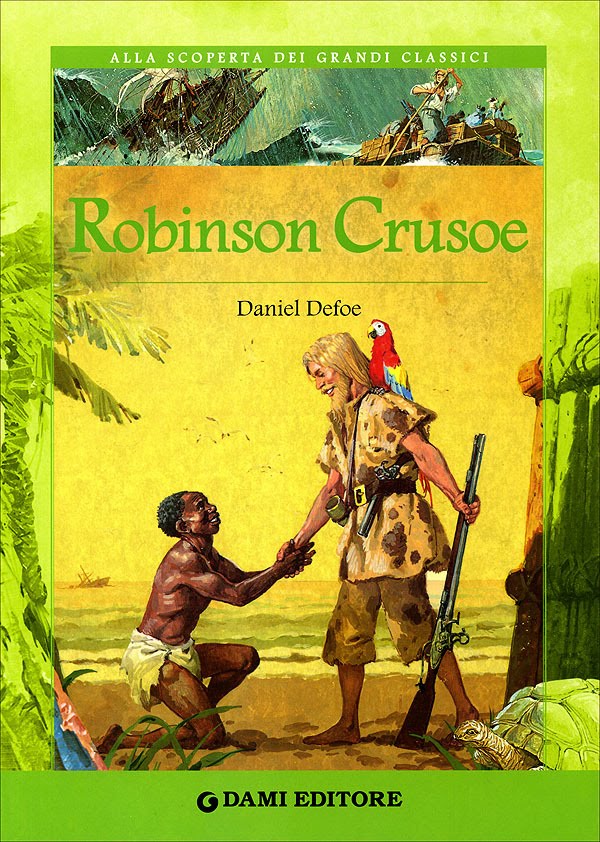
Robinson Crusoe by Daniel Defoe

Robinson Crusoe, is a novel by Daniel Defoe. First published in 1719, it is sometimes considered to be the first novel in English. The book is a fictional autobiography of the title character—a castaway who spends 28 years on a remote tropical island near Venezuela, encountering Native Americans, captives, and mutineers before being rescued.

The story was likely influenced by the real-life Alexander Selkirk, a Scottish castaway who lived four years on the Pacific island called "Más a Tierra" (in 1966 its name was changed to Robinson Crusoe Island), Chile.


Illustration by Félix Lorioux (1872-1964).


Illustration by VojtÄ›ch KubaÅ¡ta (1914 – 1992).


CHAPTER VIII—SURVEYS HIS POSITION

I mentioned before that I had a great mind to see the whole island, and that I had travelled up the brook, and so on to where I built my bower, and where I had an opening quite to the sea, on the other side of the island. I now resolved to travel quite across to the sea-shore on that side; so, taking my gun, a hatchet, and my dog, and a larger quantity of powder and shot than usual, with two biscuit-cakes and a great bunch of raisins in my pouch for my store, I began my journey. When I had passed the vale where my bower stood, as above, I came within view of the sea to the west, and it being a very clear day, I fairly descried land—whether an island or a continent I could not tell; but it lay very high, extending from the W. to the W.S.W. at a very great distance; by my guess it could not be less than fifteen or twenty leagues off.

I could not tell what part of the world this might be, otherwise than that I knew it must be part of America, and, as I concluded by all my observations, must be near the Spanish dominions, and perhaps was all inhabited by savages, where, if I had landed, I had been in a worse condition than I was now; and therefore I acquiesced in the dispositions of Providence, which I began now to own and to believe ordered everything for the best; I say I quieted my mind with this, and left off afflicting myself with fruitless wishes of being there.

Besides, after some thought upon this affair, I considered that if this land was the Spanish coast, I should certainly, one time or other, see some vessel pass or repass one way or other; but if not, then it was the savage coast between the Spanish country and Brazils, where are found the worst of savages; for they are cannibals or men-eaters, and fail not to murder and devour all the human bodies that fall into their hands.

With these considerations, I walked very leisurely forward. I found that side of the island where I now was much pleasanter than mine—the open or savannah fields sweet, adorned with flowers and grass, and full of very fine woods. I saw abundance of parrots, and fain I would have caught one, if possible, to have kept it to be tame, and taught it to speak to me. I did, after some painstaking, catch a young parrot, for I knocked it down with a stick, and having recovered it, I brought it home; but it was some years before I could make him speak; however, at last I taught him to call me by name very familiarly. But the accident that followed, though it be a trifle, will be very diverting in its place.


[...]
I cannot express what a satisfaction it was to me to come into my old hutch, and lie down in my hammock-bed. This little wandering journey, without settled place of abode, had been so unpleasant to me, that my own house, as I called it to myself, was a perfect settlement to me compared to that; and it rendered everything about me so comfortable, that I resolved I would never go a great way from it again while it should be my lot to stay on the island.

I reposed myself here a week, to rest and regale myself after my long journey; during which most of the time was taken up in the weighty affair of making a cage for my Poll, who began now to be a mere domestic, and to be well acquainted with me. Then I began to think of the poor kid which I had penned in within my little circle, and resolved to go and fetch it home, or give it some food; accordingly I went, and found it where I left it, for indeed it could not get out, but was almost starved for want of food. I went and cut boughs of trees, and branches of such shrubs as I could find, and threw it over, and having fed it, I tied it as I did before, to lead it away; but it was so tame with being hungry, that I had no need to have tied it, for it followed me like a dog: and as I continually fed it, the creature became so loving, so gentle, and so fond, that it became from that time one of my domestics also, and would never leave me afterwards.


CHAPTER IX—A BOAT

But first I was to prepare more land, for I had now seed enough to sow above an acre of ground. Before I did this, I had a week’s work at least to make me a spade, which, when it was done, was but a sorry one indeed, and very heavy, and required double labour to work with it. However, I got through that, and sowed my seed in two large flat pieces of ground, as near my house as I could find them to my mind, and fenced them in with a good hedge, the stakes of which were all cut off that wood which I had set before, and knew it would grow; so that, in a year’s time, I knew I should have a quick or living hedge, that would want but little repair. This work did not take me up less than three months, because a great part of that time was the wet season, when I could not go abroad. Within-doors, that is when it rained and I could not go out, I found employment in the following occupations—always observing, that all the while I was at work I diverted myself with talking to my parrot, and teaching him to speak; and I quickly taught him to know his own name, and at last to speak it out pretty loud, “Poll,” which was the first word I ever heard spoken in the island by any mouth but my own. This, therefore, was not my work, but an assistance to my work; for now, as I said, I had a great employment upon my hands, as follows: I had long studied to make, by some means or other, some earthen vessels, which, indeed, I wanted sorely, but knew not where to come at them. However, considering the heat of the climate, I did not doubt but if I could find out any clay, I might make some pots that might, being dried in the sun, be hard enough and strong enough to bear handling, and to hold anything that was dry, and required to be kept so; and as this was necessary in the preparing corn, meal, &c., which was the thing I was doing, I resolved to make some as large as I could, and fit only to stand like jars, to hold what should be put into them.

Illustration by Milo Winter (1888- 1956).
Robinson Crusoe: I Wanted No Sort of Earthenware.


CHAPTER X—TAMES GOATS

[..]
I soon found I had but a little passed by the place where I had been before, when I travelled on foot to that shore; so taking nothing out of my boat but my gun and umbrella, for it was exceedingly hot, I began my march. The way was comfortable enough after such a voyage as I had been upon, and I reached my old bower in the evening, where I found everything standing as I left it; for I always kept it in good order, being, as I said before, my country house.

I got over the fence, and laid me down in the shade to rest my limbs, for I was very weary, and fell asleep; but judge you, if you can, that read my story, what a surprise I must be in when I was awaked out of my sleep by a voice calling me by my name several times, “Robin, Robin, Robin Crusoe: poor Robin Crusoe! Where are you, Robin Crusoe? Where are you? Where have you been?”
I was so dead asleep at first, being fatigued with rowing, or part of the day, and with walking the latter part, that I did not wake thoroughly; but dozing thought I dreamed that somebody spoke to me; but as the voice continued to repeat, “Robin Crusoe, Robin Crusoe,” at last I began to wake more perfectly, and was at first dreadfully frightened, and started up in the utmost consternation; but no sooner were my eyes open, but I saw my Poll sitting on the top of the hedge; and immediately knew that it was he that spoke to me; for just in such bemoaning language I had used to talk to him and teach him; and he had learned it so perfectly that he would sit upon my finger, and lay his bill close to my face and cry, “Poor Robin Crusoe! Where are you? Where have you been? How came you here?” and such things as I had taught him.

However, even though I knew it was the parrot, and that indeed it could be nobody else, it was a good while before I could compose myself. First, I was amazed how the creature got thither; and then, how he should just keep about the place, and nowhere else; but as I was well satisfied it could be nobody but honest Poll, I got over it; and holding out my hand, and calling him by his name, “Poll,” the sociable creature came to me, and sat upon my thumb, as he used to do, and continued talking to me, “Poor Robin Crusoe! and how did I come here? and where had I been?” just as if he had been overjoyed to see me again; and so I carried him home along with me.
[...]


Illustration by Alexander Frank Lydon (1836-1917).
"Robinson Crusoe awakened from sleep by his parrot".
Very well bearded by this time, he lies on the ground in his garden, a rude fence in the rear.


Illustration by Alexander Frank Lydon (1836-1917).
"Robinson Crusoe at dinner with his little family".
His dog, two cats and the parrot sit nearby as he has a meal in his house.


CHAPTER XI—FINDS PRINT OF MAN’S FOOT ON THE SAND

It would have made a Stoic smile to have seen me and my little family sit down to dinner. There was my majesty the prince and lord of the whole island; I had the lives of all my subjects at my absolute command; I could hang, draw, give liberty, and take it away, and no rebels among all my subjects. Then, to see how like a king I dined, too, all alone, attended by my servants! Poll, as if he had been my favourite, was the only person permitted to talk to me. My dog, who was now grown old and crazy, and had found no species to multiply his kind upon, sat always at my right hand; and two cats, one on one side of the table and one on the other, expecting now and then a bit from my hand, as a mark of especial favour.
[...]

Illustration by Elenore Plaisted Abbott (1875 – 1935).
Robinson Crusoe with His Parrots and Cats.


Robinson Crusoe with His Parrots and Cats.


Robinson Crusoe with His Parrots and Cats.


Lit Defoe Robinson Crusoe B 192 (Ii).


CHAPTER XIII—WRECK OF A SPANISH SHIP

I was now in the twenty-third year of my residence in this island, and was so naturalised to the place and the manner of living, that, could I but have enjoyed the certainty that no savages would come to the place to disturb me, I could have been content to have capitulated for spending the rest of my time there, even to the last moment, till I had laid me down and died, like the old goat in the cave. I had also arrived to some little diversions and amusements, which made the time pass a great deal more pleasantly with me than it did before—first, I had taught my Poll, as I noted before, to speak; and he did it so familiarly, and talked so articulately and plain, that it was very pleasant to me; and he lived with me no less than six-and-twenty years. How long he might have lived afterwards I know not, though I know they have a notion in the Brazils that they live a hundred years.
[...]
Crusoe teaches his parrot to talk.


Crusoe teaches his parrot to talk.


Robinson Crusoe Talks to Parrot
Date: ca. 1980-1996
Photographer: Leonard de Selva
Collection: Corbis Art


CHAPTER XV—FRIDAY’S EDUCATION

After I had been two or three days returned to my castle, I thought that, in order to bring Friday off from his horrid way of feeding, and from the relish of a cannibal’s stomach, I ought to let him taste other flesh; so I took him out with me one morning to the woods. I went, indeed, intending to kill a kid out of my own flock; and bring it home and dress it; but as I was going I saw a she-goat lying down in the shade, and two young kids sitting by her. I catched hold of Friday. “Hold,” said I, “stand still;” and made signs to him not to stir: immediately I presented my piece, shot, and killed one of the kids. The poor creature, who had at a distance, indeed, seen me kill the savage, his enemy, but did not know, nor could imagine how it was done, was sensibly surprised, trembled, and shook, and looked so amazed that I thought he would have sunk down. He did not see the kid I shot at, or perceive I had killed it, but ripped up his waistcoat to feel whether he was not wounded; and, as I found presently, thought I was resolved to kill him: for he came and kneeled down to me, and embracing my knees, said a great many things I did not understand; but I could easily see the meaning was to pray me not to kill him.
I soon found a way to convince him that I would do him no harm; and taking him up by the hand, laughed at him, and pointing to the kid which I had killed, beckoned to him to run and fetch it, which he did: and while he was wondering, and looking to see how the creature was killed, I loaded my gun again. By-and-by I saw a great fowl, like a hawk, sitting upon a tree within shot; so, to let Friday understand a little what I would do, I called him to me again, pointed at the fowl, which was indeed a parrot, though I thought it had been a hawk; I say, pointing to the parrot, and to my gun, and to the ground under the parrot, to let him see I would make it fall, I made him understand that I would shoot and kill that bird; accordingly, I fired, and bade him look, and immediately he saw the parrot fall. He stood like one frightened again, notwithstanding all I had said to him; and I found he was the more amazed, because he did not see me put anything into the gun, but thought that there must be some wonderful fund of death and destruction in that thing, able to kill man, beast, bird, or anything near or far off; and the astonishment this created in him was such as could not wear off for a long time; and I believe, if I would have let him, he would have worshipped me and my gun. As for the gun itself, he would not so much as touch it for several days after; but he would speak to it and talk to it, as if it had answered him, when he was by himself; which, as I afterwards learned of him, was to desire it not to kill him. Well, after his astonishment was a little over at this, I pointed to him to run and fetch the bird I had shot, which he did, but stayed some time; for the parrot, not being quite dead, had fluttered away a good distance from the place where she fell: however, he found her, took her up, and brought her to me; and as I had perceived his ignorance about the gun before, I took this advantage to charge the gun again, and not to let him see me do it, that I might be ready for any other mark that might present; but nothing more offered at that time: so I brought home the kid, and the same evening I took the skin off, and cut it out as well as I could; and having a pot fit for that purpose, I boiled or stewed some of the flesh, and made some very good broth. After I had begun to eat some I gave some to my man, who seemed very glad of it, and liked it very well; but that which was strangest to him was to see me eat salt with it. He made a sign to me that the salt was not good to eat; and putting a little into his own mouth, he seemed to nauseate it, and would spit and sputter at it, washing his mouth with fresh water after it: on the other hand, I took some meat into my mouth without salt, and I pretended to spit and sputter for want of salt, as much as he had done at the salt; but it would not do; he would never care for salt with meat or in his broth; at least, not for a great while, and then but a very little.

Shipwrecked Robinson Crusoe and Friday in their desert island abode with cat, parrot and and goat, from Daniel Defoe's novel, "The Life and Strange Surprising Adventures of Robinson Crusoe."
Date taken: 1901
source: LIFE photo archive hosted by Google


Illustration by Albert Edward Jackson (1873-1952).


Illustration by Albert Edward Jackson (1873-1952).


Illustration by Albert Edward Jackson (1873-1952).


Illustration by Elenore Plaisted Abbott (1875 – 1935).
Robinson Crusoe Shoots a Parrot Which He and Friday Eat for Supper.


Illustration by VojtÄ›ch KubaÅ¡ta (1914 – 1992).


Robinson Crusoe and Friday.